

What can Performance Psychology Learn from Religion?
Many of the psychological skills we teach today have been practised in religious traditions for centuries.
Gratitude.
Forgiveness.
Mindfulness.
Living according to your values.
Taking meaningful rest.
Surrendering yourself to something greater than your present self.
As I've learnt more about performance psychology, I've been consistently struck by the similarities between many evidence-based psychological approaches and religious teachings.
There always seemed to be common themes between the two.
Now, before anyone closes this page thinking I'm about to try and convert them...
I'm not.
Religion can be an incredibly personal topic, and people's beliefs differ enormously. This article isn't about whether one religion is right, wrong or better than another…
I'm interested in a different question.
What can performance psychology learn from the practices humans have been using for thousands of years to navigate challenge, uncertainty, purpose and suffering?
For context, I have some deep personal interest in this topic…
My dad is a history professor, so many of my childhood holidays involved detours to churches, burial grounds and ceremonial locations…
As a child, this was mind numbing (I wanted to play football!).
But as I have gotten older (and it has become apparent I will never be a professional footballer), I have become very interested in religion and the history of human society more generally.
For much of human history, religion has shaped how societies understood purpose, morality, community and what it meant to live a good life. Long before psychology became a scientific discipline, religions were already asking questions about how humans should think, behave, manage adversity and flourish.
As I've studied psychology, I have often found myself thinking:
"Hmmmmm… I've heard something very similar before."
Whether it's Acceptance and Commitment Therapy (ACT) encouraging us to live in alignment with our values...
Positive psychology highlighting the importance of gratitude...
Mindfulness teaching us to be present...
Or research showing the benefits of rest, forgiveness and belonging...
Many of these ideas have reminded me of religious traditions that are hundreds, if not thousands, of years old.
I’m not saying religion invented psychology.
Or that psychology proves religion.
What I am suggesting is that many religious traditions appear to have developed practices that modern psychological research now supports as being beneficial for wellbeing, resilience and, in many cases, performance.
In this article, I'd like to explore where those worlds overlap.
We'll look at the evidence for religion and faith supporting high performance, the psychological mechanisms that might explain why, and finish with three lessons we can all learn from religious traditions (whether we're religious or not).
So...

Deed - Attribution 2.0 Generic - Creative Commons: Ljubljana Cathedral, AKA St Nicholas Cathedral | Ljubljana C… | Flickr
How do religion and performance psychology overlap?
For most of human history, religion wasn't simply about explaining the universe. It also provided a framework for how people should live.
It offered guidance on how to respond to many facets of the human experience: suffering, temptation, uncertainty, success, failure, relationships and purpose.
Today, psychologists ask many of these same questions.
The difference is that psychology uses the scientific method to test which approaches reliably improve wellbeing and performance.
The interesting thing about this is, that as our evidence base builds, many of the practices that modern research supports have existed within religious traditions for centuries…
Our ancestors appear to have had an exceptional grasp on how to encourage human thriving and sustainable success!
Let's explore a few examples.
Learning One: Values over feelings
One of the biggest shifts I've experienced as a psychologist is realising that high performance is not about always feeling motivated or confident.
It's about acting consistently in line with your values, even when motivation disappears or confidence is lacking.
Acceptance and Commitment Therapy (ACT), one of the leading therapies in Sport Psychology is built around this exact principle!
Rather than trying to eliminate uncomfortable thoughts and emotions, ACT encourages people to identify what truly matters to them and continue taking actions consistent with those values, even in the presence of discomfort (Hayes et al., 2006).
Sound familiar?
Most major religions encourage remarkably similar ideas.
Christianity speaks about serving others, loving your neighbour and acting faithfully rather than simply following emotion.
Islam emphasises submission, discipline and living according to Allah's guidance rather than immediate desires.
Buddhism encourages detachment from temporary, fleeting emotions and attachment to values such as compassion and wisdom.
Judaism places significant emphasis on living according to ethical principles through everyday actions.
Different religions, different beliefs…
One remarkably similar psychological principle.
Performance psychology increasingly shows that athletes who anchor themselves to values, and corresponding behaviours, rather than emotions are often more resilient during setbacks because motivation naturally fluctuates whereas values remain relatively stable.
As such, we can choose to take action in alignment with our valued ways of being, not acting based on temporary feelings and emotion.
Perhaps one lesson from religion is this:
Don't ask yourself how you feel today. Ask yourself who you want to be today.
Learning Two: Gratitude isn't just being nice
Gratitude appears in almost every major religion.
Whether it is saying grace before a meal, beginning prayer with thanks or recognising life's blessings, gratitude has been practised for thousands of years.
For a long time, many people assumed gratitude was simply a moral virtue.
Psychology now suggests it may also be a tool for developing and sustaining both wellbeing and performance.
Research consistently links gratitude with greater wellbeing, lower stress and stronger relationships. Systematic reviews also suggest gratitude interventions can improve life satisfaction and psychological health (Kerry et al. 2023).
For athletes specifically, emerging evidence suggests gratitude is associated with lower burnout, greater satisfaction and improved psychological wellbeing (Osherow et al. 2026).
I have even seen it applied as a mental skill of sorts, with endurance athletes such as David Roche talking about being grateful for the painful sets and reps in training, as this is where real growth occurs.
Learning Three: Rest is productive
One thing we can often neglect is rest and recovery. In the pursuit of more productivity, we draw the conclusion that to get more done, to perform better, rest is a waste of time.
Many religious traditions disagree.
Judaism introduced the Sabbath.
Christianity teaches to Sabbath on Sunday.
Islam structures daily life around regular pauses for prayer.
Buddhism incorporates periods of meditation and reflection.
These weren't simply religious rituals.
They were well planned pauses.
Psychology tells us that sustained performance depends upon cycles of stress and recovery.
Without adequate recovery we see impaired decision making, increased emotional reactivity, higher injury risk, reduced learning and, over the long term, burnout and even career termination (Madigan et al. 2022; Ortiz et al. 2019; Rajpoot, 2026).
Elite athletes don't improve during training.
They improve when they recover from training.
They improve with rest.
Perhaps humans have understood this for much longer than modern science.

England and France Players Praying Together: England and France players lauded for praying together after World Cup thriller - Yahoo Sports
So... does religion improve performance?
The evidence is actually quite interesting.
A systematic review of religion and spirituality in sport concluded that religious and spiritual beliefs can help athletes cope with uncertainty, manage competitive anxiety, build resilience and improve wellbeing, although the mechanisms differ between individuals and cultures (Noh and Shahdan, 2020).
But it is important to note, this is not:
Religion makes you perform better.
It’s instead:
Religion may provide psychological resources that support performance.
Those resources include:
meaning;
purpose;
social support;
hope;
gratitude;
forgiveness;
acceptance;
disciplined routines.
Modern psychology has spent decades studying many of these individually.
Using all manner of qualitative and quantitative tools and approaches.
Religion has often practised them collectively.
Three lessons we can all take away
Whether you're religious or not, I think there are three ideas worth borrowing.
1. Turn to your values to guide your behaviour.
Your emotions will change, they can be fleeting and uncontrollable.
Your values don't have to.
2. Build rituals that support performance.
Whether that's gratitude, reflection, prayer, journaling or mindfulness...
Consistent helpful habits that work for you.
3. Remember you are part of something bigger than today's performance.
Many religions encourage people to see themselves as part of a wider purpose or community.
Psychology increasingly suggests that having meaning beyond immediate success protects wellbeing and resilience during setbacks.
This may take the form of family, supporting your community, having another professional endeavour…
Winning is important.
But it when it becomes your entire identity, this can be unhelpful.
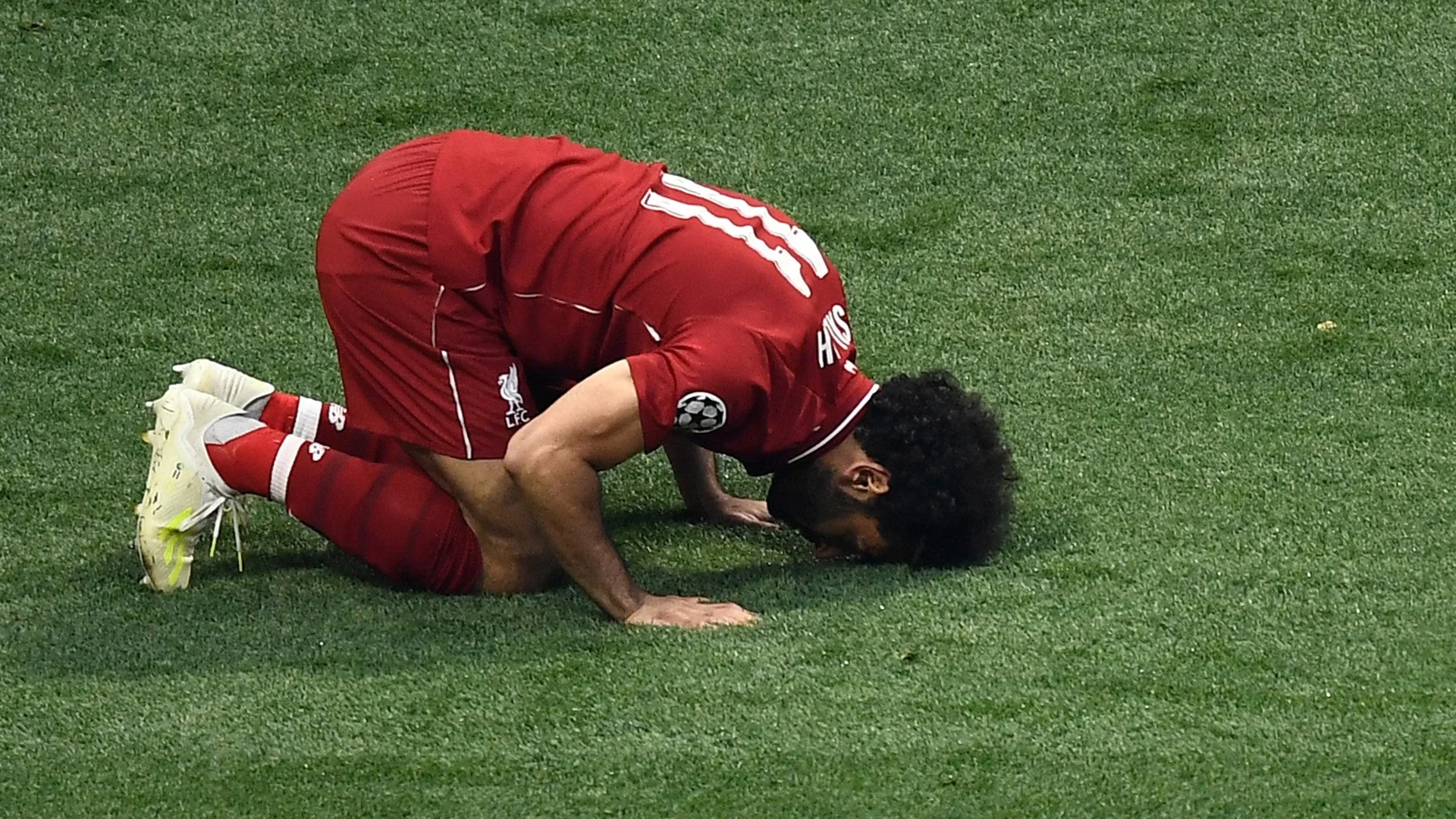
Explained: Mohamed Salah goal celebrations & meaning behind Liverpool star's on-pitch gestures | Sporting News
Final thoughts
The more I've studied psychology, the more I have seen how it crosses over quite neatly to the lessons religion has been putting forward for centuries.
Psychology provides the science.
Religion often provides centuries of lived experience.
That doesn't mean every religious belief or practice is scientifically supported.
Nor does it mean psychology validates religion.
What it does suggest is that humans have been searching for effective ways to flourish for a very long time, and, although not perfect, have often been pretty darn good at it!
I hope this post has sparked some reflections.
In a CPD I attended last year, a very intelligent and accomplished practitioner noted how psychology is rooted in philosophy. Although it has become a science across time, I think the overlaps between religion and modern psychology still gives weight to this.
I find faith, religion and it’s influence on human society and human psychology incredibly interesting, so if you have more to add, please do comment down below.
I am, as always, incredibly grateful for your time.
Have a great week.
Thank you,
Frazer
References:
Madigan, D. J., Ren, F., Mallinson-Howard, S. H., Backhouse, S. H., & Vallerand, R. J. (2022). Relationship between athlete stress and burnout: A systematic review and meta-analysis. International Journal of Sport and Exercise Psychology, 20(5), 1399–1426.
Hayes, S. C., Luoma, J. B., Bond, F. W., Masuda, A., & Lillis, J. (2006). Acceptance and Commitment Therapy: Model, processes and outcomes.Behaviour Research and Therapy, 44(1), 1–25.
Noh, Y.-E., & Shahdan, S. (2020). A systematic review of religion/spirituality and sport: A psychological perspective. Psychology of Sport and Exercise, 46, 101603.
Kerry, N., Chhabra, R., & Clifton, J. D. W. (2023). Being thankful for what you have: A systematic review of evidence for the effect of gratitude on life satisfaction. Psychology Research and Behavior Management, 16, 4799–4816.
Ortiz, R. O., Sinclair Elder, A. J., Elder, C. L., & Dawes, J. J. (2019). A systematic review on the effectiveness of active recovery interventions on athletic performance of professional-, collegiate-, and competitive-level adult athletes. Journal of Strength and Conditioning Research, 33(8), 2275–2287.
Rajpoot, Y. S., Choudhary, P. K., Choudhary, S., et al. (2026). From slump to comeback: Psychological determinants of performance decline, burnout, and recovery in competitive athletes—A systematic review. Sports, 14(5), 165-184.
