

Cowboy Up! Authenticity for Winning Big
In 2004, the Boston Red Sox broke the legendary “curse of the Bambino”, and ended an 86-year Championship drought… Sweeping the St Louis Cardinals in the World Series off the back of overcoming a 3-0 deficit to their arch rivals, the New York Yankees, in the American League Championship series. The first team to ever overcome a 3-0 series deficit in MLB history.
An unbelievable feat of resilience and success against all the odds, and a story neatly packaged and portrayed through a recent Netflix docuseries titled “The Comeback”.
Having far too much time on my hands, I spent the past weekend watching this series, once again finding my performance psychology brain whirring with reflections...
So, what was the main take away this time?
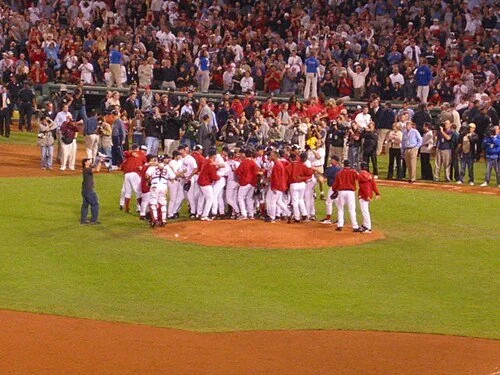
The Boston Red Sox celebrate a win over the Baltimore Orioles in the 2003 Wildcard game.
Credit: Dudesleeper
Authentic Social Identity Drives Deeper Victory
The thing that stood out to me, throughout the series, was just how much fun this team was having and how fondly they remembered their time together.
Pippa Grange speaks about “winning big” in her book “Fear Less”. Referring to how true wins are not just lifting trophies, but winning in a way that is authentic and aligns with your values and deeper purpose.
What I saw in this docuseries, was a team that was winning BIG.
Stories of celebrating with fans in local bars (still in their cleats and uniforms), shaving their heads as a team, sticking up for each other when matches boiled over into physical confrontations, nights (and days) spent drinking together, watching their favourite shows, laughing, joking and genuinely connecting with one another.
A group of self-proclaimed “idiots”, on a mission to break an 86-year curse and bring a World Series trophy back to the great sporting city of Boston.
Now, why does this stick out so heavily to me?
Well, it’s because to some, this type of behaviour would indicate a lack of professionalism (especially the drinking and fighting!). A sign that this team of elite athletes were simply not taking their jobs seriously.
At points, the organisation could have even taken the line that their conduct was damaging the teams image, and looked to apply punitive measures… All of which may have been a justified angle to take.
But, that is not what happened.
The owners and management recognised that this team needed that local club house feel. They were not the New York Yankees (that was already taken… by the New York Yankees). This was Boston.
To censor this team and punish them for being themselves would have stripped them of the very identity that made them unique.
To apply sport psychology research, we could say that the Boston Red Sox had formed a clear social identity, one that differed them from other MLB teams. Social identity theory suggests that a group forms a collective sense of self through shared norms and behaviours. Reinforcing their own intra-team connections by noting how they differ from other groups.
In particular, the Red Sox had positioned themselves as the antithesis of the clean shaven, big city, superstar Yankees.
In this instance, the Red Sox were the “idiots”, the plucky underdogs, the MLB equivalent of a bare knuckle street fighter, who was more than happy to take a few punches before knocking you out and sitting straight back down for triple JD and coke.
The Yankees on the other hand, were a seasoned world championship cruiserweight, pulling up in a Rolls Royce with a Rolex on, used to putting you down in the first round before you even knew the bell had rung.
This difference in identity was key. By positioning themselves as the opposite of their arch rivals, the Red Sox became more closely connected.
And this connection mattered.
When the team found themselves 3-0 down against the Yankees, talent alone was not enough. Plenty of talented teams have folded under similar pressure (every team in MLB history in fact).
But, Boston possessed something deeper, a belief in one another that had been built long before they found themselves on the cusp of being swept by their arch rivals.
Manager Terry Francona recalls thinking before game 4 of the American League Championship Series (a must win game for the Red Sox), “we’re a bunch of crazy f**ks, but we believe in each other and we’re not gonna back down from anybody”, after he saw his team watching TV together, laughing, joking and sharing a meal ahead of the biggest match of their lives later that evening.
And you know what?
That “bunch of crazy f**ks” went and won that game, and every game after that until they lifted the World Series trophy!
Now, I am not saying that as a leader, you should allow your team to do whatever they like in the pursuit of authenticity and “good vibes”. Yes, these things help to create the conditions for connection within a team, but the best teams still need the essential performance ingredients.
High standards and accountability.
Without these two, elite performance simply will not occur.
What I am saying, is that sometimes to unlock your teams true potential, you need to understand what it is that makes you unique.
What does your team do that is different to your rivals?
What does your team do better than everyone else?
What do you and your teammates love the most about being part of your team?
Once you identify the answers to these, you can double down and leverage what you’ve found. Remind your team of what makes them different, what makes them better than the rest and find a way to do more of what you love.
Now, I could go down a rabbit hole of how to understand your team members’ beliefs, values and ways of behaving… but this would become a 4000 word essay. So, I will leave it there for today.
Thank you very much for reading, you’ve done an amazing job if you’ve made it this far!
I hope it has been helpful and prompted some useful reflections for your own life.
Have a great week.
Frazer
