

5 Performance Psychology Themes to Watch for: Premier League 2026/27
The Premier League is usually discussed through tactics, transfers, injuries and form. But underneath all of those sit some interesting psychological challenges.
The 2026/27 season has plenty..
Arsenal are no longer chasing the title, they're defending it. Sunderland have gone from survival being the goal to dealing with the weight of expectation. Many of the league's best players are returning from an exhausting World Cup. Marcus Rashford has an opportunity to add new chapter to his Manchester United story. And Manchester City are working out what life after Pep Guardiola looks like.
None of this means we can diagnose what is happening psychologically from the outside. We can't know whether a player is lacking confidence, a team is complacent or a dressing room is struggling with pressure simply by watching them play.
But sport psychology gives us some useful ideas about the demands these situations can create and what might help athletes and teams navigate them.
Here are five I'll be watching out for…
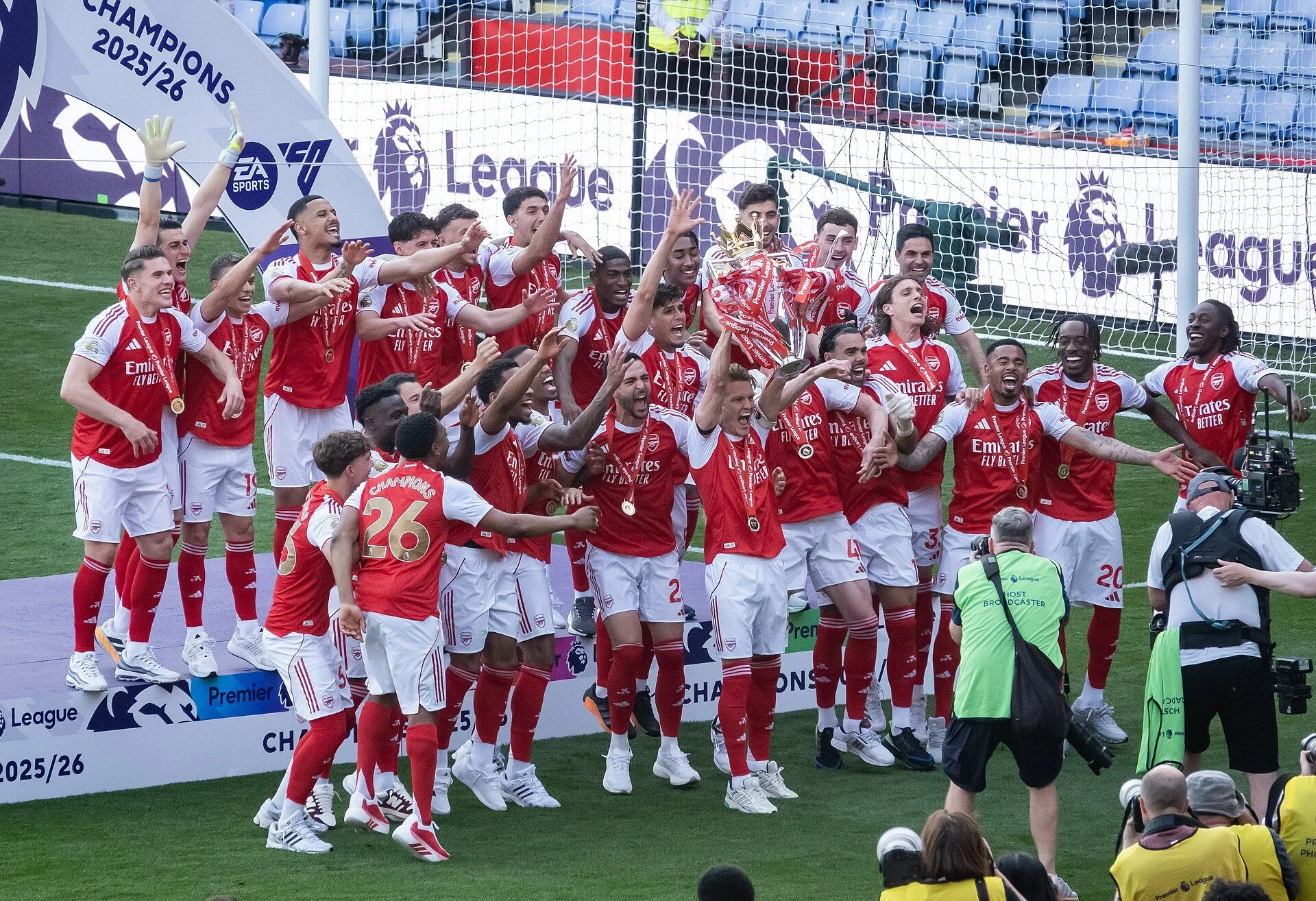
Chensiyuan, CC BY-SA 4.0 <https://creativecommons.org/licenses/by-sa/4.0>, via Wikimedia Commons
1. Arsenal: From hunters to hunted
For several years, Arsenal had something very clear to chase.
The Premier League title.
Last season they finally caught it.
That creates an interesting psychological problem. Because achieving a goal doesn't necessarily create the same motivational conditions required to achieve it again.
Arsenal are no longer trying to prove they can become champions. They are champions. Other teams have another season of information about how they play. Every opponent gets the opportunity to beat the champions. And performances will inevitably be compared with the standard Arsenal established last year.
It would be easy to frame the challenge as:
“Can Arsenal avoid becoming complacent?”
But I think that's too simplistic.
The more interesting question is where the next source of improvement comes from.
Achievement Goal Theory distinguishes between orientations centred around demonstrating superiority and those centred around mastery, learning and improvement (Nicholls, 1984).
That distinction could become important for Arsenal.
If the goal becomes “we have to defend our title”, attention can easily move towards protecting something they already have.
What if instead the challenge becomes:
How much better can this team become?
Can Arteta identify new tactical problems for his players to solve? Can individual players develop different dimensions to their games? Can the team establish standards that aren't dependent on whether they're currently first in the league?
Success doesn't have to reduce motivation.
But sometimes you need a new mountain once you've climbed the old one.
2. Sunderland: When survival becomes expectation
Sunderland experienced almost the opposite psychological journey last season.
They entered the Premier League with survival a natural reference point and dramatically exceeded it.
That changes things.
Supporters have now seen what the team can do. Players have evidence that they belong at this level. Opponents have a full season of footage to analyse. And, performances that previously represented progress, may suddenly be judged against what Sunderland achieved last year.
Success changes the pressure attached to the same task.
Challenge and threat theory provides an interesting lens here.
Broadly, whether we experience a demanding situation as more of a challenge or threat is influenced by how we evaluate the demands we're facing relative to the resources we believe we have available to cope with them (Jones et al., 2009).
Imagine Sunderland entering a difficult away game last season.
The opportunity might have felt enormous. Go and show everyone what we can do.
Now imagine essentially the same fixture after a successful first season.
Suddenly there might be something to protect.
We're supposed to be good now.
People expect us to win these games.
We need to prove last season wasn't a fluke.
The football hasn't necessarily changed.
The meaning attached to it has.
When perceived demands begin to outweigh perceived resources, performers can move towards a threat state, associated with less adaptive physiological responses and, on average, poorer performance (Moore et al., 2012).
So one of the most interesting things to watch will be how Sunderland define success.
Can they remain focused on development, execution and their own trajectory?
Or does last season gradually become a standard they feel compelled to defend?
One of the strange consequences of success is that it can increase what you believe you now have to live up to.
3. The post-World Cup problem: The body isn't the only thing that needs to recover
For many Premier League players, this hasn't really been an off-season.
They've gone from the demands of a long domestic campaign into arguably the biggest competition of their lives.
Then straight back towards another Premier League season.
The physical implications are obvious.
But I'm interested in the psychological recovery too.
A World Cup isn't just another block of football.
For some players, it will represent the fulfilment of a childhood ambition. Others will return having experienced devastating elimination. Some may have spent weeks away from their families only to barely play. Others will have dealt with enormous scrutiny, responsibility and pressure.
Two players can therefore return to their clubs with identical numbers of minutes played and completely different psychological experiences.
This matters because recovery isn't simply the absence of exercise…
Research into athlete burnout and stress-recovery balance highlights the importance of managing accumulated psychological as well as physical demands (Gustafsson et al., 2017; Kellmann, 2010).
And the solution won't necessarily be “give everyone more rest.”
One player might need time away.
Another might desperately want the familiarity of club football.
Someone else might benefit from having a completely new goal to pursue.
Which makes individualisation important.
The body might be ready to play before the person feels refreshed by playing.
The effects might not even be most visible in August.
I'll be interested in what these players look like in February and March, when another 30 games have been added to a season that arguably never really had a psychological reset.
4. Marcus Rashford: Can you change the story without changing the past?
Marcus Rashford returning to Manchester United under Michael Carrick creates perhaps the most obvious individual psychology storyline.
Because Rashford isn't returning to a blank page.
There is history there.
Great performances. Difficult performances. Criticism. Managerial changes. Loans. Supporter expectations. Media narratives.
And potentially, stories Rashford himself has developed about what Manchester United means to him and who he is when he plays there.
This is where ideas from Acceptance and Commitment Therapy (ACT) become interesting.
ACT describes cognitive fusion: the tendency to become so caught up in a thought or story that we begin responding to it as though it is simply reality (Hayes et al., 2006).
In sport, those stories might sound like:
“I've already failed here.”
“The fans have made their minds up about me.”
“I'm not the player I used to be.”
Trying to convince yourself that none of those thoughts exist isn't necessarily the solution.
Neither is pretending the past didn't happen.
The psychologically flexible response is being able to recognise:
That's a story my mind is giving me… what does this moment actually require from me?
Carrick's role could be interesting here too.
A new manager can provide different expectations, different relationships and different opportunities. Most importantly, Rashford has the opportunity to accumulate new experiences.
A good training week.
A positive interaction with the manager.
Executing his role well.
A goal.
Another good performance.
Eventually, the evidence available to construct the story changes.
You don't have to rewrite the past before you take action towards the future you want.
5. Manchester City: How do you follow Pep without trying to be Pep?
Following a successful leader is difficult.
Following someone who has shaped almost every aspect of how an organisation operates for a decade is something else entirely.
That is the challenge facing Enzo Maresca at Manchester City.
There is an important caveat here: Maresca isn't walking into an unfamiliar organisation.
He knows City. He worked within Guardiola's environment. There will be considerable overlap in their footballing ideas, language and understanding of the game.
That familiarity could be enormously useful.
Because one of the things established teams develop is a shared understanding of how situations are supposed to unfold.
Eccles and Tenenbaum (2004) describe how expert sporting teams develop shared knowledge structures that support coordination and anticipation.
Players don't need to consciously negotiate every decision.
They begin to know what other people are likely to do.
Rip all of that up immediately and you potentially remove something extremely valuable.
But there is another side to the challenge.
At some point, this has to become Maresca's Manchester City.
If every tactical decision, team selection or defeat is evaluated against “What would Pep have done?”, the previous era risks becoming a constraint on the new one.
That creates an interesting balancing act between continuity and change.
Keep the principles that still serve the team.
Keep the shared language and understanding that gives players clarity.
But allow new ideas to emerge too.
Maresca doesn't necessarily need to prove he's different by immediately changing everything.
Nor does he need to recreate Guardiola's City perfectly.
Perhaps the challenge of succeeding greatness isn't replacing it. It's deciding what deserves to survive — and having the confidence to evolve everything else.
The bigger picture
What makes these storylines interesting is that none of them have an obvious psychological solution.
Arsenal don't simply need to “stay hungry.”
Sunderland don't simply need to “ignore expectations.”
World Cup players don't all need more rest.
Rashford doesn't simply need confidence.
And Maresca doesn't simply need to copy what worked before.
Performance psychology is usually more nuanced than that.
The same situation can create completely different demands for different athletes and teams. Context matters. History matters. How the performer interprets the situation matters.
And that's what makes these five worth watching.
The Premier League won't just test who has the best players or tactics this season. It will continually ask players and teams to adapt to what success, failure, pressure, fatigue and change mean to them.
References
Nicholls, J. G. (1984). Achievement motivation: Conceptions of ability, subjective experience, task choice, and performance. Psychological Review, 91(3), 328–346.
Ames, C. (1992). Classrooms: Goals, structures, and student motivation. Journal of Educational Psychology, 84(3), 261–271.
Jones, M., Meijen, C., McCarthy, P. J., & Sheffield, D. (2009). A theory of challenge and threat states in athletes. International Review of Sport and Exercise Psychology, 2(2), 161–180.
Moore, L. J., Vine, S. J., Wilson, M. R., & Freeman, P. (2012). The effect of challenge and threat states on performance: An examination of potential mechanisms. Psychophysiology, 49(10), 1417–1425.
Gustafsson, H., DeFreese, J. D., & Madigan, D. J. (2017). Athlete burnout: Review and recommendations. Current Opinion in Psychology, 16, 109–113.
Kellmann, M. (2010). Preventing overtraining in athletes in high-intensity sports and stress/recovery monitoring. Scandinavian Journal of Medicine & Science in Sports, 20(Suppl. 2), 95–102.
Hayes, S. C., Luoma, J. B., Bond, F. W., Masuda, A., & Lillis, J. (2006). Acceptance and commitment therapy: Model, processes and outcomes. Behaviour Research and Therapy, 44(1), 1–25.
Eccles, D. W., & Tenenbaum, G. (2004). Why an expert team is more than a team of experts: A social-cognitive conceptualization of team coordination and communication in sport. Journal of Sport & Exercise Psychology, 26(4), 542–560.
