

Norway, Vikings and Psychological Safety
Norway have been one of the “Dark horses” of this year's World Cup. Having overcome five-time champions Brazil, the Norsemen now face England in what promises to be a huge test for both nations.
On paper, their success shouldn't be a complete surprise.
Their squad is packed with elite talent. Erling Haaland. Martin Ødegaard. Antonio Nusa. Oscar Bobb. Kristoffer Ajer. Alexander Sørloth. Jørgen Strand Larsen. Some of the finest footballers in the world.
They've also paid attention to every marginal gain. Reports suggest they've even imported food from Norway to ensure players and staff have access to familiar, high-quality nutrition throughout the tournament.
Then there's Norway's broader sporting philosophy.
For decades, youth sport in Norway has prioritised enjoyment, belonging and long-term development over early results. Children aren't ranked in league tables at younger ages, and the emphasis is on helping young people stay in sport because they love it, rather than because of external rewards or pressure. This approach aligns closely with research on Self-Determination Theory, which suggests that environments supporting autonomy, competence and relatedness foster more sustainable motivation and long-term performance (Deci & Ryan, 2000).
These things all matter.
But I want to talk about something else.
Something that's much harder to measure.
The power of connection.
More specifically... the power of connection to create psychological safety.

By حسن مازن - Own workعمل شخصي, CC BY-SA 4.0, https://commons.wikimedia.org/w/index.php?curid=194134020
Edmondson (1999) defines psychological safety as "a shared belief that the team is safe for interpersonal risk taking."
In simple terms, it's the feeling that you can make a mistake, ask a question, try something difficult or speak up without fear of humiliation, rejection or being cast aside.
That might not sound particularly relevant to elite sport.
In reality, it's everything.
At a World Cup, every touch of the ball is broadcast across the globe.
Millions of supporters are watching.
Pundits are analysing every decision.
Opposition fans are criticising every mistake.
Journalists are writing headlines.
Scouts are evaluating performances.
Entire nations are judging players in real time.
That's an extraordinary amount of pressure.
Imagine if the whole world watched you at work…
Every email you sent was dissected online.
Every typo became evidence that you weren't good enough.
People questioned your salary because you arrived two minutes late to a meeting.
Every coffee break became proof that you lacked commitment.
How would you behave?
Personally, I'd probably read every email five times before pressing send.
I'd overthink every contribution in meetings.
I'd become slower, more cautious and far less willing to take risks.
Even then, I'd still feel anxious.
Football is no different… Except the decisions need to happen in fractions of a second.
The best pass.
The right run.
The perfectly timed tackle.
There isn't time to overthink.
Which is why psychological safety matters.
Now imagine something different.
Imagine you're not performing for millions of strangers.
Imagine you're performing in front of your closest friends.
People who genuinely want you to succeed.
People who'll support you when things don't quite come off.
Would you play differently?
I know I would.
I'd make decisions more quickly.
I'd trust my instincts.
I'd worry less about making mistakes and focus more on performing.
That appears to be something Norway have cultivated—not just within the squad, but across the entire nation.

By Nicholas Roerich - http://roerih.ru/rerih/34.php, Public Domain, https://commons.wikimedia.org/w/index.php?curid=21505002
One of the most visible examples is the team's post-match Viking Clap, where players and supporters come together in a shared celebration. It's a simple ritual, but symbolically powerful. Everyone is in the same boat, rowing in the same direction.
The players also seem unusually open with supporters.
Behind-the-scenes videos, changing-room footage and social media content—often featuring players like Erling Haaland—give supporters an insight into the personalities behind the performances.
It breaks down barriers.
It builds trust.
It creates connection.
The relationship becomes less "us versus them" and more "we're in this together."
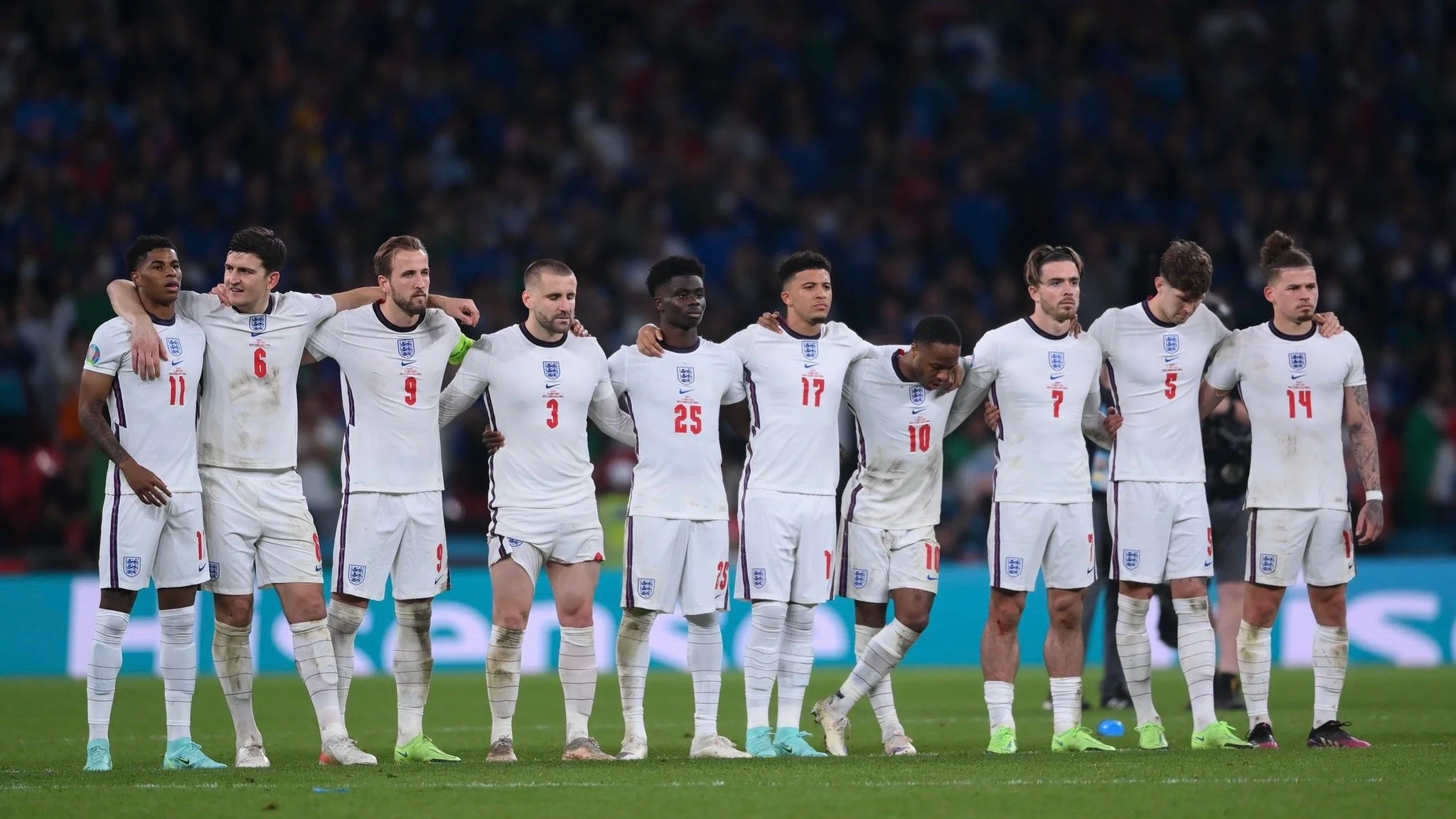
Take The Knee and Stand Up to Racism; solidarity with English footballers : Peoples Dispatch
That isn't always the case in international football.
History offers plenty of examples where the relationship between players, supporters and the media has fractured.
France's internal conflict during the 2010 World Cup became one of football's most infamous collapses.
David Beckham endured years of public vilification following England's exit from the 1998 World Cup.
Bukayo Saka, Jadon Sancho and Marcus Rashford were subjected to horrific racist abuse after England's penalty shootout defeat in the Euro 2020 final.
Experiences like these inevitably create distance.
Players become guarded.
Supporters become frustrated.
Trust erodes.
And once that relationship breaks down, pressure only increases.
Norway seem to have taken a different path.
By inviting supporters into the journey rather than keeping them at arm's length, they've fostered a genuine sense of connection.
Instead of feeling like they're performing in front of millions of critics...
They're performing alongside millions of supporters.
Psychological safety doesn't remove pressure.
The World Cup is still the World Cup.
Mistakes still matter.
The stakes couldn't be higher.
What psychological safety appears to do is change how athletes experience that pressure.
Instead of worrying about the consequences of failure, more attention can be devoted to the task itself. Research into performance under pressure suggests that anxiety consumes valuable attentional resources and working memory, making skilled performance more difficult (Beilock & Carr, 2001).
When performers feel trusted and supported, they're more likely to stay focused on execution rather than evaluation.
And that unlocks something incredibly valuable.
Risk-taking.
Creativity.
Quick decision-making.
Authenticity.
Of course, connection alone doesn't win football matches.
You still need…
Outstanding players.
Excellent coaching.
Physical preparation.
Tactical organisation.
A little luck never hurts either…
But when two exceptional teams meet, the psychological environment can become the difference-maker.
The teams that play with freedom are often the teams willing to attempt the difficult pass, make the brave run or take the shot others hesitate to take.
Those moments decide tournaments.
So, what can we learn from this?
Whether you're coaching athletes, leading a business, teaching in a classroom or raising a family, the principle is remarkably similar.
When people feel judged, they protect themselves.
When people feel connected, they express themselves.
Creating psychological safety doesn't mean lowering standards or accepting mediocrity. In fact, Edmondson's work consistently shows that psychological safety is most powerful when paired with high accountability.
The goal isn't to remove pressure.
It's to remove unnecessary fear.
As leaders, coaches, teachers or parents, we might ask ourselves a few simple questions:
Do people around me feel comfortable making mistakes?
Do they feel safe asking questions or admitting they don't know something?
Do they believe I'll support them when things don't go wrong?
Am I creating an environment where people perform to impress me, or one where they perform because they feel supported by me?
The best teams don't just build talent.
They build trust.
And perhaps that's Norway's greatest strength.
Not simply a generation of world-class footballers.
But a culture where players feel they're performing with millions of teammates, rather than millions of critics.
So, what have you taken from this that you can apply within your team?
I hope it has been of some value, and thank you for reading this far.
Have a great week!
Frazer
References
Beilock, S. L., & Carr, T. H. (2001). On the Fragility of Skilled Performance: What Governs Choking Under Pressure? Journal of Experimental Psychology: General, 130(4), 701-725. https://doi.org/10.1037/0096-3445.130.4.701
Deci, E. L., & Ryan, R. M. (2000). The "What" and "Why" of Goal Pursuits: Human Needs and the Self-Determination of Behavior.Psychological Inquiry, 11(4), 227-268. https://selfdeterminationtheory.org/SDT/documents/2000_DeciRyan_PIWhatWhy.pdf
Edmondson, A. C. (1999). Psychological Safety and Learning Behavior in Work Teams.Administrative Science Quarterly, 44(2), 350-383. https://doi.org/10.2307/2666999
